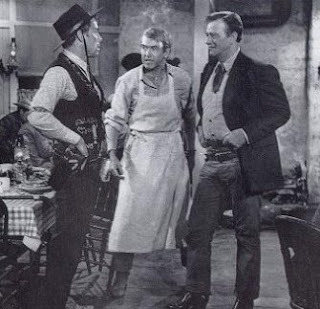
I was quite ignorant about this film, I must admit. Obviously, since it was directed by John Ford and starred Jimmy Stewart, John Wayne and Lee Marvin I knew it couldn't be bad but the cheesy Burt Bacharach title song did its reputation no favours and I'm ashamed to say I dismissed it as just another western. I recorded it when it was on TV about a year ago but I never got round to watching it. So when I found it on this list (which doesn't feature Stagecoach, Unforgiven and High Noon among other notable westerns) it was a little surprising. I was also very pleased when I discovered that the Bacharach song didn't have anything to do with the film either!
Jimmy Stewart plays a senator who returns with his wife to their home town to attend the funeral of an old friend. The newspaper men are curious to know the details of why he would come back to pay his respects to a "nobody" so he tells them the tale. It's fairly standard western fare for the most part: an educated and non-violent man from the East comes to town, gets robbed, tries to fight his battles using law and his sense of civilised justice but finds that the sword can be mightier than the pen. There are gunfights and saloons and tough men eating big steaks but there are also some interesting insights into American politics of the period which in some ways hasn't changed at all.
Stewart is always good, of course, but the standout performances here are from the supporting cast — particularly Edmund O'Brien as the newspaper editor who likes a drink and the sound of his own voice and Woody Strode as John Wayne's loyal sidekick. Wayne himself was a limited actor but had great screen presence and was constantly watchable — surely the definition of a true film star.
It's hard to talk too much about themes without giving away the ending. We have the old standby of so many westerns: civilisation coming to the West and how it parallels the story of the USA. We have the central triangle of Jimmy Stewart's idealist, John Wayne's pragmatist and Lee Marvin's anarchist — facets of a single character or facets of America itself? All very Film Studies 101 but there are some more interesting questions being asked here too — about the flexibility of law and the role of myth in American history. Its answers are quite pessimistic really, but I'll leave you to draw your own conclusions.
A top Western, and well worth its place at no. 60.
So here are the facts and figures. I've based this all on 248 films — the 250 listed minus Family Feud and Song Cycle. Who the hell would be credited as directory of Family Feud anyhow? This also leaves in the entries which are double-counted, so you may want to mentally remove them from the figures: Vivre Sa Vie/My Life To Live, Dog Star Man/The Art of Vision and Pather Panchali/The Apu Trilogy. The last of those pairs should probably count as three, actually.
Colour or Black and White
150 out of the 248 are Black and White films (60%).
Silent or Talkie
40 are silent films (16%).
Countries Represented
This is slightly difficult as a lot of films have multiple nationalities. I tried where I could to pick the primary country of origin, which is usually the language spoken or the nationality of the director.
USA
116
France
41
Italy
17
Japan
16
Germany
15
USSR
9
UK
9
Denmark
4
Sweden
4
Poland
3
Belgium
2
India
2
Canada
2
Iran
1
Mexico
1
Hungary
1
Senegal
1
Hong Kong
1
Taiwan
1
Greece
1
Brazil
1
Not a big shock that USA and France lead the way, but perhaps a bit surprising that Italy and Germany are so high up. The poor old UK doesn't fare well at all and seems to be absent a lot of key works — where's David Lean? I suppose we should be consoled that there are a lot of British directors in the list.
Directors
Here are the directors with two or more films to their name:
Jean-Luc Godard
9
Alfred Hitchcock
7
Robert Bresson
6
Buster Keaton
6
Akira Kurosawa
6
Yasujiro Ozu
5
Orson Welles
5
DW Griffith
5
Carl Theodor Dreyer
5
Stanley Kubrick
4
Stan Brakhage
4
Rainer Werner Fassbinder
4
John Ford
4
Howard Hawks
4
Charlie Chaplin
4
Sergei Eisenstein
3
Roberto Rossellini
3
Preston Sturges
3
Michelangelo Antonioni
3
Martin Scorsese
3
Jean Renoir
3
Ingmar Bergman
3
Federico Fellini
3
F W Murnau
3
William A Wellman
2
Werner Herzog
2
Vittorio de Sica
2
Satyajit Ray
2
Andrei Tarkovsky
2
Robert Altman
2
Douglas Sirk
2
Pier Paolo Pasolini
2
Oliver Stone
2
Nicholas Ray
2
Michael Powell
2
Max Ophüls
2
Chantal Akerman
2
Francis Ford Coppola
2
François Truffaut
2
Luis Buñuel
2
Louis Feuillade
2
Kenji Mizoguchi
2
John Cassavetes
2
Fritz Lang
2
James Cameron
2
Bernardo Bertolucci
2
Georges Méliès
2
So Godard wins it with 9 (which should probably be 8) ahead of crowd favourite Hitchcock. Interesting that there are only 3 American directors in the top ten, two of whom were from the silent era.
Decades
Finally, a look at when these films were made:
1900s
2
1910s
6
1920s
28
1930s
26
1940s
28
1950s
43
1960s
48
1970s
36
1980s
19
1990s
12
An indication that cinema has declined in the past thirty years, or just that it takes time to recognise a great film for what it is?
I've now been through the whole list (and will post some statistics later) but there are a few question marks. Things would be much simpler if Thomas Edison laid down in law right from the start that every film could have only one title and every title could only belong to one film. Then you wouldn't have so many remakes — surely a good thing — and you'd also clear up a lot of confusion.
Imagine if a beautiful woman comes up to you in a bar and says "Hey baby, do you want to come back to my place to watch Crash on DVD?" Quite the dilemma, I'm confident you're all thinking. If she means the Paul Haggis film you'll surely regret saying yes as you sit there watching two hours of overwrought Oscar-grubbing. But if she means the Cronenberg film and you say no you'll miss out on a hell of a night. So you tiresomely ask her and she discards you and moves on to the next sap. Damn you Haggis! Why on earth would you title your film the same as a (better) film just 8 years older?
It's even worse when films have different titles in different countries. Which version the voters in this poll intended isn't always at all clear.
Take China Gate. There's a 1957 American war film of that title. It looks ok but hardly seems a must-see, so maybe they mean the 1998 Bollywood film instead? That gets a decent enough write-up too but I'd be surprised if anyone voted it best of the century. I can't believe either film is the one intended, but I can't find any other references out there. A puzzler.
Family Feud is equally puzzling. As Chris pointed out in the comments, this is the American version of rubbish gameshow Family Fortunes ("and our survey said..."). Surely they can't mean that, though, and this is really some sort of documentary or experimental work? Not that I can find anywhere.
Iliad has a number of possibilities. In the end I've gone for Manfred Noa's 1924 Helen of Troy which seems the most plausible but I could easily be wrong.
Imitation of Life could really be either version. Each seems equally likely to me. The same goes for The Ten Commandments but with that I'm guessing the 1956 version, mostly because that's the one I've seen.
L'Argent could be the fairly well-known 1983 Bresson film or the less well-known but apparently equally revered 1928 film.
Is Parade really just the 1974 Jacques Tati film about the circus? There seem a lot of films with this title, but that's the best of an unlikely bunch.
Song Cycle I have absolutely no clue about. There's the well-regarded Van Dyke Parks album with this title, but that won't be it. Nor will it be the 1928 film A Cycle of Songs which has received no votes on IMDB at all.
There are six Buster Keaton films on the list and I'd only seen The General before, so I thought I'd tick the other five off and write about them in one go. For those of you who like old films, I highly recommend archive.org which has tons of silent films for free download. They're all out of copyright so it's perfectly legal. The quality's not always that good but it's still watchable.
37. Sherlock, Jr. (1924)
In this first one — the most unconventional of the six — Buster plays a projectionist who wants to be a detective and tries to solve the case of a missing watch. But he's not very good at it and after a few comic misadventures his girlfriend finds the culprit without much trouble at all. The plot is more or less wrapped up in twenty minutes, but what follows is a dream sequence that takes up most of the rest of the film and features an awesome array of set-pieces as Buster jumps into a movie screen where he takes on the role of the super detective. Two scenes stand out, but it's all golden. First Buster jumps head-first through a window where he had carefully positioned a box, emerges from the other side wearing a dress that was in the box, and immediately imitates an old woman to evade his pursuers. You can't help but rewind it and watch it again and wonder how on earth it was filmed. The other notable scene is where Buster rides on the handlebars of a motorcycle (the other rider having fallen off) and negotiates various obstacles, collapsing bridges and oncoming trains. It's seriously dangerous stuff which you could never get away with filming nowadays but you have to just sit there and marvel at it.
220. The Navigator (1924)
The weakest of the six, The Navigator is more a series of sketches than a fully coherent narrative. There's some tenuous story about a young couple who get stranded on a passenger ship which is cast adrift on the ocean but it doesn't make much sense. The set-pieces range from the very good to the corny. In one Buster has trouble putting together a deck-chair — hilarious stuff! The underwater sequences are well done and the finale is quite impressive as the duo fight off a bunch of savage cannibals. It's not very politically correct, but it's very inventive and exciting. A good enjoyable film, but I have no idea why the person who voted it onto the list ranked it above the other five here.
The most modern of the six — the plot wouldn't look out of place in a 90's rom-com — this one has Buster needing to get married in a day in order to inherit a huge sum. He messes it up with his sweetheart but, undeterred, he goes on a quest to propose to anyone he can find. First he asks the seven single women at his club, with predictable results, then he walks down the street chatting up everybody he meets. He even approaches, unknowingly, a black woman, a Jew and a drag queen. Brilliant stuff — as if a white man could ever marry one of those people. Comedy gold.
Such dubious moments aside, though, this film is laden with gags, no more so than in the final segment where he's pursued by an army of brides-to-be as he races to marry his sweetheart (who's forgiven him) by the deadline. The stunts and acrobatics are astounding and genuinely more impressive than anything you find in today's cinema. Jackie Chan is said to have been inspired by Keaton but he never reached these heights.
If you watch this on Youtube (linked above), watch out for the colour scenes right at the start — not bad for 1925.
32. The General (1927)
This is Keaton's Pet Sounds. The work which had gone before was undoubtedly very good, but he really stepped up with The General which is a more grown-up and polished film. Set in the American Civil War, Buster plays a man who is shunned by his friends for not being allowed to enlist in the Confederate army but gets caught up in events when some Unionists steal his beloved steam train (the eponymous General) and he heads off in pursuit. There's so much to love here, but the highlights have to be the two train chases which are so inventive and exciting. You wouldn't think that you could get much creative mileage from a chase sequence where the vehicles are confined to a linear track, but under Keaton's direction you get everything.
The General is quite critical of war and patriotism, a fairly brave statement at the time and probably why the film tanked at the box office. Most of the soldiers in the film are arrogant and pompous and generally a bit incompetent. Buster isn't much better. He runs rings around his enemies, but not usually from any great wit or superior soldiery — most of the time he succeeds by pure blind luck. The motives for war are noticeably absent, too. Buster doesn't seem interested in any of the reasons for fighting for the South — he just wants to look good wearing the uniform for his girl. Nor does he chase after the bad guys because he wants to stop the enemy from carrying out their dastardly plan, or even because he wants to save his lady from their evil clutches — he just wants to get his train back. He's still the hero, of course, and saves the day like every hero should. But he's a fairly pitiable hero, perhaps a point Keaton was trying to make about soldiers in general.
Incidentally, the version embedded above has a really weird soundtrack — it kicks off with Elgar for no particularly good reason and the first few minutes are quite hard to watch. I think it gets better later on, though. I have it on DVD where the soundtrack is a much more appropriate Scott Joplin. It's quite interesting how important sound is for a silent film! Also, ignore the title cards right at the start — they aren't on the DVD version and are both irrelevant and spoil the plot a little.
46. Steamboat Bill, Jr. (1928)
This one is a strange affair. Maybe it's because I saw this film last of the six, but it didn't impress me. It's 70 minutes long and the first 55 of them are pretty dire, to be frank. We're talking sub-Chuckle Brothers physical comedy as Buster falls off things, walks into things and tries on silly hats. I was struggling to keep watching, but I did know what was to come as this is the film with his most famous scene.
There really isn't much of a story. Buster is the public-school educated son of a salty old riverboat captain. His sweetheart is the daughter of a rival riverboat owner, but Romeo and Juliet this isn't. The dad gets arrested and Buster makes a bizarre attempt to free him from prison, though I'm not sure what would have happened if he'd succeeded. But then a cyclone hits and the film changes completely. The last 15 minutes are truly magnificent as the town is destroyed by the winds. We see houses lift up off their foundations, trees being uprooted and blown across town, buildings topple over and in amongst the wreckage flies Buster. Some of the scenes are quite remarkable and have rightly gone down in cinema history. The rumour was that he was suicidal and so took ridiculous risks for the sake of making these sensational stunts but whatever the truth, the end product is amazing.
It's still worth sitting through the movie to get to the end, but you're probably better off just fast-forwarding it to its conclusion.
112. The Cameraman (1928)
This was Keaton's first movie for MGM and the last of his great films. MGM would afterwards remove creative control and therefore all that was good about his films. Morons. Buster plays a cameraman who wants to shoot footage for the news and win the heart of a girl who works at the news office. There's nothing particularly new or revolutionary about this film compared to the other five — it's just a very well executed comedy. Again, it's the finale that impresses with two brilliant scenes. First, a shootout between rival Chinese gangs and then a boating accident and daring rescue. The rest of the film is pretty good, too, although the visit to the swimming pool feels a bit out of place in the middle.
Buster also gets himself a monkey sidekick, which can never be a bad thing. I think most films could be improved if the hero had a monkey sidekick.
I was already a Buster Keaton fan on the basis of one film, but now I've seen all these six my love for the little stony-faced acrobat is confirmed. Nevertheless, I am a little surprised at how well some of these films rank. The General, of course, is rightly near the top of the pile. An almost perfect film, Orson Welles said it was the greatest comedy ever, the greatest war film ever and probably the greatest film ever too. Sherlock, Jr. is imaginative and fantastical and tremendous fun. The rest also have moments of brilliance — some more than others — but are still fairly patchy. I'll concede that Steamboat Bill, Jr. should be included on the basis of its final act alone, but I'm not convinced about the rest. But who cares — they're all terrific entertainment even after all these years and it would take a very cold-hearted person to sit through them without a big grin on their face.
P.S. It seems the embedded videos are too wide to fit in this column, and I don't really want to widen the column. If you do want to watch them, you'll have to full-screen it (the button that's cut off furthest on the right) or go to archive.org and see them there.
Easily the oldest film on the list, Le Voyage Dans La Lune is now 108 years old. There are various versions out there — short versions (at 25 fps and therefore speeded up from the original), long versions (the original 16 fps), versions with rock music, versions with narration, colourised versions, etc. etc. The first version I saw had just a soundtrack but it's impossible to follow. This version made sense of the story by reading the original script like they would have done at the theatre it was first shown, but the sound is fairly amateurish:
The film is pretty poor, frankly. Yes, it's groundbreaking, it has great special effects for its time and fantastical sets. It's also admirably ambitious. Where other film makers were content with replicating a stage play on the big screen, Georges Méliès made a science fiction movie with aliens and rocket ships. I recommend you all watch it as it's an intriguing bit of film history but, as a film, it's pretty terrible. The plot is nonsense and just involves a bunch of magicians flying to the moon, killing off some natives and falling back to earth. It's cartoonish but not in a good way.
There isn't really any acting to speak of, either. Part of this might be down to the narrative style of the film being so alien — directors hadn't yet learned the language of cinema and how to tell a story in the new medium. There are no close-ups — just a static camera sitting away from the action as if we're in the front row of the theatre. There's no voice acting either (duh) so there's no way for the actors to express themselves other than jumping around and pointing at things — you don't see their faces. It just feels very clunky.
It does have one glorious moment, though, and that's the iconic image we've all seen before of the rocket flying into the moon's eye. It's worth it for that at least.
It's not the oldest film I've seen, though. That would be this. Cool to say you've seen it, but that's as far as it goes. Why is the old woman in the background walking backwards, though?
Not a new film off the list, but something I've seen again recently. You may be familiar with La Jetée as the basis for Gilliam's Twelve Monkeys. It's a fascinating piece of cinema as it involves almost no action at all — just a series of still photographs with a voice-over and soundtrack. The story involves a prisoner in a post-apocalyptic society being sent backwards and forwards in time in an effort to save the human race. It's a fairly simple tale, actually, but the way in which it's told is quite mesmerising and it really draws you in. You have to get over the fact that the time machine is just a woman's bra, though.
It's only 26 minutes long so watch it.
[It seems they took this video down so you'll just have to Google it. Or buy the DVD, you cheapskate!]
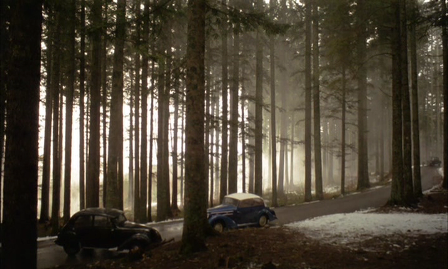
This was on TV earlier this year, but I only got round to watching it at the weekend. It's Bernardo Bertolucci's 1970 film* about fascist Italy and one man struggling with his place in it.
The most obvious and immediate quality about it is how incredible it looks. In the early scenes we see enormous sets depicting various government buildings. Many are quite surreal, for example this is apparently a mental asylum:
Towards the end we get this stunningly lit scene in the snowy woods:
Everything about the film is designed immaculately for both visual and emotional appeal but it's not just a pretty face — there's depth to it too.
The surreal start isn't limited to just the sets. It takes a while to understand exactly what is going on and the mixing about of time periods and use of disorienting camera angles doesn't help things. Of course, this is all very deliberate as these are the sequences set in Italy. Once they cross the border into France things become more conventional and the story begins to become a bit clearer.
The conformist of the title, a man called Clerici, isn't exactly one of cinema's great heroes. He's a sexually confused product of a drug addict and a lunatic and, like most sexually confused products of drug addicts and lunatics, he just wants to lead a normal life. Unfortunately in 1930's Italy this means becoming a slave to the fascist state, a role he nevertheless embraces. How Clerici deals with the sacrifice of his ideals is what the piece is about, but you won't see him unshackle himself, overcome his oppressors, kill Mussolini, and flee to freedom on a tropical island — it's much more realistic than that and consequently much more cynical.
It also has blind people having a fight.
* I should probably use the word "masterpiece" here, but I suspect that such clichés will get a bit repetitive after a while.
There are a lot of rather random films on this list. It seems that it was put together by asking film critics to supply their top ten and a number of the films towards the bottom have just one low-ranked vote. For example, Justine Elias made some eccentric choices for her films 8-10 and this was enough to rank them on the overall list. This will have skewed things somewhat at the bottom. Still, it also makes things interesting and will reveal a few films that might not have made other lists. One person thinks the Joan Crawford film Trog (no. 240) is one of the best of the century, so that must mean it's worth a look even if it looks dreadful and gets "9 beans" in this review.
The Zapruder Film at no. 112 is slightly odd, but you can't argue against its historical significance. Porky in Wackyland (also no. 112) I thought must be a joke, but I suppose you could say it was a landmark. But then there is no. 229 El Paso Wrecking Company which presumably is the same as gay porn film El Paso Wrecking Corp.? Why Dennis Dermody thinks this is the 8th best film of the last century, I have no idea.
I watched this on a Romanian video site. I've embedded it here, but I'm not sure how long it's likely to stay there. Watch it if you can, though, as it's pretty strange and only 7 minutes long.
I'm not convinced that this is really a masterpiece of 20th century film-making but it's certainly interesting, packed full of sight-gags and surrealist flights of fancy. Great silly fun.
So this was the film that inspired me to start this blog. If such a good film could pass me by all these years what other gems have escaped me? Laziness is the reason that I haven't yet got round to watching All About Eve (it's been sitting on my freeview box for about a year now unwatched) but ignorance is the reason I hadn't seen Sunrise.
I watched it on Youtube, where you can find it in nine 10-minute parts. The quality is fine for Youtube, but if you want to watch it on your 40" plasma telly you might want to get the DVD instead.
I'm not going to play the film critic — there are far more learned writers out there than me (for example they would use than I) — and neither am I going to pointlessly spew out the plot which will just be dull for those who have seen it and spoil things for those who haven't. Instead I intend to simply jot down some impressions of the films I watch. There will inevitably be some spoilers but I'll try to only reveal as much as any newspaper review would reveal and I promise not to give away any endings.
One thing that really struck me is how unusual Sunrise is, at least to my modern eyes. This might sound rather trite but it genuinely reminded me of Bollywood films with their pot pourri of action, drama, romance, comedy and everything else under the sun. Sunrise has romance in spades, of course, but also very funny scenes, psychedelic fantasy scenes, melodrama, scenes of dramatic tension. There are special effects (at least, what passed for special effects in 1927), elaborate sets, dancing and even a drunken animal doing a slapstick routine — something which sadly we don't see in many mainstream films nowadays.
But most striking of all is how dark it is in places. The first segment is like something out of a gothic horror film (it has the same director as Nosferatu after all) with mist sweeping over the swamp, grotesque villagers gossiping and a man bewitched by an evil harpy. We see this man's tormented eyes and heavy walk as he contemplates and almost carries out an unforgivable crime. Later on he confronts a stranger who has been rude to his wife. It doesn't last long but his reaction is terrifying with a real — almost psychotic — malice. This kind of character just isn't seen as a romantic lead in today's cinema and the experience is a little strange.
The film presents itself as some kind of fable (the characters are called "The Man", "The Wife" etc.) but I'm not entirely sure what the moral of the story is supposed to be apart from perhaps giving some hope to the Ike Turners of the world. Maybe more subtle metaphors will reveal themselves with further viewings but that's not really what interests me here. I've read reviews which describe this as the last great film of the silent era and mourn the backwards step that cinema took with the introduction of sound and I can completely see the point — it's visually enthralling from the first scene to the last, shot by a director at the height of his powers. But its narrative is equally strong — powerful and frightening and sad — and it's for this reason that the film is so astonishing in my opinion. Everybody should see at least one silent film and I can't think of a better example.