Friday, 28 January 2011

43. Sunset Blvd.

Sunset Blvd. — aka Sunset Boulevard, there seems to be some debate about what the actual title is — is one of the daddies of American cinema and it's a bit of a shocker that I'd not seen it until just before Christmas. It's the story of struggling screenwriter William Holden who stumbles into the house of silent film star Gloria Swanson, once a world famous idol but now a deluded has-been. He sticks around to help her with a screenplay she's written and gets entangled in her life as she prepares for a comeback.

Swanson as Norma Desmond is superb and rightly earns the plaudits but I think the best thing about the film is William Holden. His character is so perfectly balanced — charming, dryly witty and not untalented but also shallow, selfish and greedy. He's young, but world-weary, and he pities Swanson and doesn't return her affection. Generally embarrassed by his situation, he's nevertheless happy to take her money and live the opulent lifestyle. Not that he's a particularly bad person; he's merely weak. When he does try to do the honorable thing and return to his life of debt and happiness, he quickly gets dragged back to the house on Sunset Boulevard. His relationship with sweet innocent Nancy Olson is another highlight: unconventional, almost unromantic, but very nicely played.
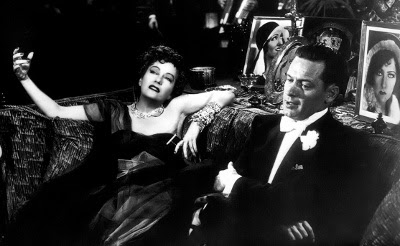


In many ways the film plays out more like a horror than a drama. Norma Desmond's palace is haunted by ghosts of her long-dead career and nowhere is this more true than in the case of her creepy butler, a fascinatingly bizarre character with some interesting twists in his backstory. Desmond is the monster, though, ensnaring the young writer in her manipulative web and subjecting him to her Busby Berkeley bathing suit recreation. But, like all the best monsters, you do feel sorry for her. And of course there's the rather morbid device of killing off the leading man at the start and having him narrate the film in flashback from beyond the grave. An earlier cut actually had his body in the morgue chatting to other occupants.

The script is superb, and not just for all the famous oft-quoted lines*. The storyline is clever, brave, tight and scathing of its chief target, the Hollywood machine which uses people for as long as they're profitable and then discards and forgets them. I'm wondering if time has actually diminished its message, though. There have been so many of these anti-Hollywood movies made in the last 60 years that we've seen it all before and know full well what lies beneath the tinsel. But when it was first released this caused quite a stir and people were shocked that they would bite the hand that fed them. Still, even if the central message has been diluted a bit over the years the film that remains is still wonderfully cynical, brilliantly made and just a lot of fun.

Oh, and you get to hear Buster Keaton talk in one of several cameos by silent-era film makers. He's playing bridge and his only words are "Pass".


* I will say, though, that the "You used to be big." "I am big. It was the pictures that got small!" exchange confuses me. If it was the pictures that got small and she stayed the same size then, in proportion to the pictures, she would have got even bigger and by her logic would be an even bigger star.

Saturday, 11 December 2010

What a good idea!

If you like this blog, but want the list to be four times longer, the writer to know what he's talking about and articles that actually have some researched depth rather than short bursts of inane ill-informed rambling, then take a look at Shooting Down Pictures. The website's a bit of a mess but there is a heck of a lot of material on there so full props to Kevin Lee for an awesome job.

That said, I believe I do still have some things to offer my readers. I've not yet finished my list, so there are still plenty of articles to come (whether this is a good thing is up to you). My articles are short enough to be read on the toilet. And when you visit my blog it doesn't auto-play a Big Lebowski video every single bloody time.

220. A Matter of Life and Death

Definitely in the "should have seen it" camp, rather than "didn't know I should have seen it", this is one of those Sunday afternoon classics that's on quite a bit but I'd never managed to catch. David Niven (always brilliant) plays the RAF pilot who's due to die over the Channel but somehow the powers that be fail to drag him off to heaven and he survives. They realise their mistake a few hours later but in the mean time he's fallen in love with a radio operator and wants to appeal his death.

Or maybe not. I'll try again. David Niven (always brilliant) plays an RAF pilot who, after crashing his plane in the Channel, gets diagnosed with a life-threatening brain tumour. This causes him to hallucinate various conversations with a French fop who claims to be his guide to the after life. Initially skeptical, as the tumour develops he starts to believe this absurd story and has to decide on who to represent him in the trial.

The film is fantastic, of course. Perfectly played, well scripted, intelligent, with some brilliant ideas. It has enough romance to give the film heart but not so much as to make it sickly. There are some great random moments, such as the naked boy on the beach (why?). The heavenly scenes (in black and white, a clever flipping of the Wizard of Oz conceit) are imaginative and funny (and you even catch a glimpse of Richard Attenborough up there) and the earthbound scenes are comfortingly British in a Dad's Army sort of way.


If there is a false note in the film, it's probably the final act. Niven's case gets heard by a celestial court which, rather bizarrely, briefly turns into an Americans vs British slanging match. It's clearly trying to make some comment on Anglo-American relations at the time but it feels a bit tacked on. As if Powell and Pressburger had a great little fantasy romance ready to shoot but the government wanted to inject some of their post-war foreign policy into the mix. I'm quibbling, though.

Despite the above, the question I'm asking myself is: did I love it? I think I have to say no. I admire it, but I didn't get that feeling of awe or excitement from it. It's undoubtedly a well-made film but in the end it just didn't capture my imagination as much as plenty of lesser films have. Perhaps it's a little dated, perhaps it's a little familiar, I'm not really sure. Maybe it needs a second viewing, but it might be a while before I get round to it.

Tuesday, 16 November 2010

112. Un Chien Andalou

I hadn't seen this before, though I of course knew about the infamous eyeball scene. Often lauded as a masterpiece, it's a French/Spanish surrealist short film by Luis Buñuel and Salvador Dali but I'm not going to describe the film any more than that — watch it and you'll understand!


I have to say I'm seriously wondering if there's an Emperor's New Clothes thing going on here. Buñuel is a revered director (who made several highly regarded films surprisingly not on this list) and Dali is one of the most famous artists of the last century, so obviously this has to be a great film. After all, that's what film students the world over are told. So how come it seems to be total shit? Oh well, it must be my shortcomings as a film watcher because all those people can't be wrong. I don't want to look like a dick so I'll just pretend that it's actually awesome.

Except I'm more than happy to look like a dick, so here's an honest review.

The most interesting thing about it is probably the fact that it's utterly meaningless. And that's not me being stupid; the writers purposefully made it void of all symbolism, metaphor or interpretation. This means that any critic who claims to possess some deep understanding of it is an idiot. There's also no plot and I'm pretty sure there aren't any characters either — there are actors in common through the piece but they're just showroom dummies on which the director dresses his bizarre scenes. Just because the girl in the opening scene looks the same as the girl running away from the bloke tied to the pianos (sigh...) doesn't mean it's the same person any more than Jake Gittes is the same person as Jack Torrance. The whole thing is just really empty and pointless.

Don't put this down to surrealism-bashing. I'm not against the movement and it led to some excellent pieces of artwork. David Lynch's backwards-talking dwarf, for example, is one of the coolest scenes in all television and is undoubtedly "surreal". True surrealism tries to express the chaos of the mind and the trip into Dale Cooper's dream psyche is perfectly weird. Un Chien Andalou, by comparison, is just very tiresome. A load of random stuff happens but you don't care about any of it, can't find any meaning in it and it's not even particularly interesting from a purely visual perspective.

Watch Porky in Wackyland instead — a much better example of surrealist film.

Tuesday, 9 November 2010

37. Metropolis

I first saw this about 15 years ago when Channel 4 showed the colour-tinted Giorgio Moroder rock opera version, running at 80 minutes. I loved it of course, and didn't even mind the music despite the multiple Razzie nominations. Then a couple of weeks ago I went to the cinema to see the newly rediscovered and lovingly restored almost complete version: pure black and white with an authentic score and a whopping 150 minute running time. Some of the difference in time is technical (the Moroder version was run at a slightly faster speed and used subtitles instead of intertitles) but also there are a lot of previously lost scenes added. In fact, there are now only a couple of scenes missing from the film shown at the 1927 Berlin premiere and they mark these in this version with title cards explaining what should be happening.

In a word, it's awesome and a completely different experience to the first time I saw it. In fact, apart from the iconic scenes everybody knows, it's as if they're two different films. If you've seen Metropolis before and you enjoyed it you owe it to yourself to catch this re-release.


The Metropolis of the title is a sprawling futuristic city with a stark division between the rich thinkers who live in luxury in their ivory towers and the practically enslaved working class who live underground and make the city's machines tick. Both halves are magnificently depicted. Above we have the incredible soaring tower blocks, opulent night-spots and fantastical transport systems - all modelled on the New York of the 20's, itself a futuristic landscape for European eyes. Down below are the machines: enormous, complex and industrial with little or no automation and requiring hordes of oppressed workers to run. The whole thing, of course, is an allegory of Communism but this wasn't the film's strong point for me. In fact, the central thesis of the film — that "between the head and the hands lies the heart" — is a bit heavy-handed (not to mention nauseating) and really didn't need to be repeated throughout the film; there is such a thing as subtext, y'know. That said, this was 1927 and audiences hadn't yet been subjected to thousands of films on this subject so maybe I'm just jaded.

While the politics might not be especially inspired, the film more than makes up for it in sexy robots. Mad scientist Rotwang — who has more than a shade of Strangelove about him — creates the man-machine to replace his dead love and it takes on the appearance of Maria, the leader of an underground movement for better working conditions. With Maria out of the way, the evil doppelgänger actually encourages the workers to rise up so that the city boss has an excuse to kill them off and replace them with an army of robots. It's not quite that simple, though, as Rotwang plans to double-cross him and his son has grown a conscience and rebels (mostly because he's trying to pull Maria).


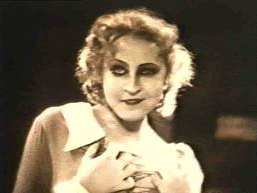
Brigitte Helm is probably the best thing about the film. It's an incredible performance: virginal and strong as Maria; deranged and sexy as hell as the robot. I can't have been the only person in the audience who preferred the evil version, though, erotically writhing around with those maniacal eyes. It is actually surprisingly risqué, not that I was complaining. Evil Maria does like to touch herself and even in metal form she's built for sex appeal. And that dance, phew! I've read that Fritz Lang (the director) was a bit of a tyrant and that the shoot was hell for many of the cast, especially Helm, but it clearly got the best out of her.

The film is chock full of iconic scenes: the transformation scene, obviously; Freder at the clock (but lord knows what mechanism he's actually working there); the children fleeing the rising flood waters; Rotwang chasing Maria through the pitch-black tunnels; and of course those amazing Futurama cityscapes. It's exciting and intelligent and massively influential to not only science fiction film makers. Perhaps in another 15 years they'll have discovered the last missing pieces in some cave in Afghanistan and I'll go and see it again.

Saturday, 30 October 2010

220. His Girl Friday

This was on TV a while back and I caught up with it last weekend. It's a 1940 screwball comedy about newspaper reporters and it's available in the public domain so I can link you to the whole film:


Cary Grant plays a scumbag editor who, as the opening title card says, will do anything short of murder to get the story. He's a real git who's quite happy to threaten women, cheat on politicians, rob and kidnap people all for the story. He's also a real charmer and very funny. Rosalind Russell — equally smart and funny — is the star journalist who's looking to get away from the business and settle down in Albany with sweet dull Ralph Bellamy. She's also his ex-wife ("I intended to be with you on our honeymoon, honest I did," says Grant). But when a story breaks she can't resist Grant pushing her back into the fray and finds that she misses her old life.

The side-story about a death row inmate is actually oddly serious. John Qualen is accused of killing a man and is sentenced to death but there's a question mark over his sanity and, since the victim was black and there are a lot of black voters in the town, there are also question marks over the motives of the politicians trying to see him executed. Then when the confused man's depressed girlfriend jumps out of a window you might think that we were watching a serious piece of drama. I guess there's some comment on the ethics of journalism too, but all that grown-up stuff is pushed swiftly aside by the tidal wave of wisecracks — many ad-libbed — from the two stars and their supporting cast.

The relationship between Grant and Russell is a little strange. He's really a terrible person and you can see why she left him. She's no happier with Bellamy, though, and over the course of the film Grant gradually worms his way back into her heart — mostly by framing Bellamy for various crimes so that he's occupied with the police. It's interesting, though, that she doesn't even consider the third option — as if to realise that both men are wrong for her would mean she dies alone. She does end up with one of them, but it's refreshingly unromantic to think that the relationship is almost certainly over a week or two at most beyond the end credits!

I can't find any hard statistics on the subject, but I wouldn't be surprised if this was the wordiest film ever made. It runs to only 92-minutes, too, so that shows just what a pace they're going at. One source clocks them at 240 words per minute, which is about double normal talking speed. I recently saw The Social Network, the Aaron Sorkin-scripted film about the founding of Facebook. It's also pretty wordy and apparently to get the script to fit a reasonable time rather than cut out sections they instead got the actors to talk faster. Whether that's true or not, it's still slow and contemplative in comparison to His Girl Friday. The dialogue is relentless, with constant jokes and humorous asides. The actors don't even wait until the other person's sentence is finished before starting their own lines. In one remarkable scene Russell, typing a story out on her typewriter, has an argument over her shoulder with Bellamy while Cary Grant barks orders over the phone about the layout of the morning edition, frequently breaking off to make jibes at the hapless fiancé. It's sheer chaos but brilliantly executed and I can only imagine how much rehearsal it needed. Some people might find it a bit too manic but I lapped it up and would recommend the film to anyone.

Saturday, 9 October 2010

82. The Texas Chain Saw Massacre

Ok, question number one: why is this film called The Texas Chain Saw Massacre, but the sequels and remake are called The Texas Chainsaw Massacre? Who decided to drop the space, and why?

Anyway, there's probably little need to tell you what goes on in this film. It's famous and even if you haven't seen it (which I hadn't until the end of August) you still know it through the many films it's influenced and Simpsons jokes referencing it. If you've seen any of the modern slasher films, too, the plot will feel familiar — a group of kids on a trip to the country meet some bad folks and some grisly ends — but this was the landmark of the genre and if not the very first was certainly the most important. As such it should be treated as a historical piece as well as an individual work.

It's quite fun to look at the similarities with Star Wars. They're both pioneering films, financially successful, enormously influential and spawned several terrible sequels. Both directors gained great acclaim but never quite reached those heights again and had — creatively at least — quite disappointing careers. And they both had beards. But that's a little unfair on Tobe Hooper and The Texas Chain Saw Massacre is a much better film than Star Wars. But it's not a great film and to be honest I was a little underwhelmed seeing it for the first time after all the hype and expectation.

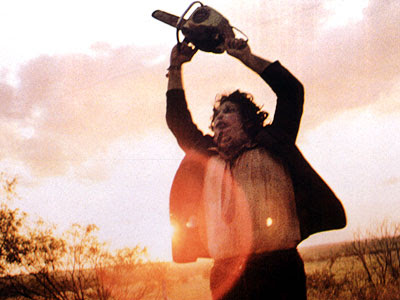
The first half hour works well, deftly building up tension in the usual way (see earlier comments on Suspiria). Then they get to the creepy old house, the tension ratchets up a few notches and the chain sawing starts. It's superb stuff — terrifying and visceral and very exciting. And considering it was made in 1974 when the audience's taste for such things wasn't quite as high as it is now makes it all the more impressive. I can quite believe all the stories about people fainting in cinemas and having to be stretchered out.

But then the film takes a bizarre left turn for the final act. We get to share a meal with Leatherface and his family and I'm not ashamed to admit I just didn't get it. It's a very poor attempt at black comedy, almost as if Hooper wanted to do a version of The Munsters but without being funny, and fits very strangely into the film that had gone before. Here's a quote from Wikipedia on the film's sequel, made in 1986:

"The emphasis in this sequel is on black comedy, which director Tobe Hooper believed was present in the first film, but unacknowledged by viewers because of its realistic and shocking content."

I like the way they say that Hooper believed it was present, as if he couldn't be sure. Or maybe he tried to put it in but it turned out so badly he decided that it wasn't there after all. Whatever the story, I'm afraid this spoiled the film for me a little. I'm happy to ignore those scenes and concentrate on the good points, of which there are plenty, but I shouldn't have to do that in a top 250 film.


We actually saw this at Frightfest in London so they had a Q+A with the director himself afterwards. I say Q+A, but it was more like nauseatingly fanboyish leading questions and embarrassingly stilted answers. A good public speaker Tobe Hooper is not and I did feel a bit sorry for the man, forced to answer these inane questions from some guy who had once written a GCSE Film Studies essay about him. One comment that did interest me, though, was when Hooper was attempting to show how different he was trying to be with the film. "No Hollywood film would have the actor jump through two windows," he proudly says. And he's probably right, but not necessarily in a good way. You can watch the interview on Youtube and he also talks a little about the black comedy aspect of the film. Mercifully a lot of the most cringe-worthy questions seem to be cut out.

I don't want to sound too critical about it because we had a good time watching it and I would still recommend it highly to anyone. And it's certainly an "important" film in the history of cinema. It's not a masterpiece, though, but why should it have to be?

Wednesday, 6 October 2010

94. Suspiria

This was on Film4 about a month ago as part of the run-up to FrightFest. It's a 1977 horror film which I'm astonished isn't as well known as other works in the genre, because it's clearly one of the best. How come Hallowe'en is shown once a year at a minimum, but Suspiria gets no more attention than a brief mention in Juno?

The plot isn't particularly revolutionary — a plucky virginal heroine heads off to a spooky dance school in Europe where people start getting bumped off — but the plot isn't so important as the style of the film. It's beautiful to look at with these wonderfully lit primary-coloured rooms. Some of the sets are quite reminiscent of The Conformist — it must be an Italian thing.


The masterstroke of director Dario Argento, though, is in the opening scenes. Most horror films like this open slowly, building up the tension, hinting at things to come and then gradually escalate to a great terrifying crescendo. That's standard fare and a lot of very good films have been made in this model (The Texas Chain Saw Massacre, reviewed next, being a prominent example). One problem with this, though, is that you get used to the film — its style and pacing — and you learn to predict, whether consciously or unconsciously, what is likely to happen. Argento, however, cunningly flips this on its head by putting all the best stuff right up front. As such, the first 20 minutes are unpredictable, disorienting, shocking and very frightening. You have no idea what's going on, no frame of reference for judging how bad it's going to get. Is it a supernatural villain or is it a human killer? Is the girl we're following the heroine of the film (and therefore safe from an early grave) or an expendable supporting character? You don't know.

As the film progresses things settle down to a more standard setup. The deaths happen at the usual intervals and in between the heroine researches the strange goings on, leading her on a path to the finale. That's not to say the deaths are uninteresting — far from it. They're just expected. Actually they're pretty cool and the girls die in lots of bizarre and sometimes extremely gruesome ways. This is not a film for the squeamish and you certainly get your money's worth in blood.

A word should be said about the soundtrack, by the Italian prog-rock group Goblin. It's just superb and plays a vital role in creating the eerie quality of the movie. Just a few notes of the main theme on the piano is enough to freak my little sister out — always a good talent to have up one's sleeve! What's interesting, too, is that it's not just the music on the soundtrack that works so well but the use of silence. A well-timed silence can send a shiver up your spine just as much as a haunting celeste.

I'm not totally convinced that this film will withstand repeat viewings because once it loses its shock and surprise it might not have a whole lot of substance to it. The Exorcist is such a great film because even after seeing it several times it's still totally enthralling. Scream, on the other hand, was enormous fun at the cinema but when I saw it again a few years later I could see the cracks. Where Suspiria comes in this hierarchy remains to be seen, but for any of you out there who haven't seen it yet, I couldn't recommend another horror film more highly.

Tuesday, 31 August 2010

62. Les Vampires

There are a few films on the list that I'm not particularly looking forward to. Don't get me wrong — I'm sure Sátántangó is a fine film and will be worth watching, but the thought of sitting down to a 7 hour Hungarian epic about Communism doesn't immediately thrill me. The same was true of Les Vampires, a 10-part 1915 silent serial running to over 6 hours, but I gladly admit I was wrong to have my doubts — it's superbly entertaining and although it's almost a century old it still feels very fresh.

Les Vampires has nothing to do with blood-sucking creatures of the night. The title refers to a group of master criminals who terrorise Paris during World War One and the story revolves around young intrepid reporter Philippe Guérande and his faithful sidekick (and brilliantly named) Oscar-Cloud Mazamette fighting against their evil ways. All but the first couple of episodes run to about 45 minutes and they stand perfectly well on their own so you can watch them occasionally while eating your lunch. Here's a link to the first episode, one of the better and shorter ones so well worth a look to see if you'll like the rest.

There are a lot of things to enjoy. Some you might find in a Boy's Own adventure story or a Tintin comic: secret passages, treasure maps, disguises, daring escapes, car chases, cunning traps, hypnosis. Some are rather more macabre: murders, suicides, severed heads in boxes, poisoned rings that kill their wearers, gas chambers. The plots are imaginative and often quite labyrinthine — you have to keep focussed if you want to follow it all! The cast list is enormous, too, and the many disguises and impersonations don't always make it easy to tell who's doing what, but that's quite fun.

One thing I really love about these silent films, which applies equally to the Buster Keaton films I wrote about earlier, is how unconstrained by studio sets they are. Directors were perfectly happy to film outside or in a real house. In later years, this became too expensive to do well and the directors retreated to sound stages where everything could be measured and controlled. Les Vampires has a terrific freedom about it and hundreds of different locations. You get to see all sorts of aspects of 1915 Paris. To be sure, it was a desolate and miserable place — there was a war on and the Western Front wasn't too far away — but that only adds to the character and sense of time the film has.

The central characters themselves are interesting and you develop a fondness for them as the series progresses. Guérande the hero is a bit bland, but his colleague Mazamette is memorable — brave and loyal, but a bit of a clown and with a rough edge. The best thing about it, though, has to be Musidora, the actress who plays Irma Vep — probably the first screen femme fatale and one of the most beautiful. Strong and deadly with incredible intense eyes, she was also an acrobat so takes part in some of the film's best stunts. She steals the show and is much more interesting than the succession of evil bosses she works for.


The picture quality isn't always brilliant, but considering the film's age this isn't too big a deal. The music is really good and fits the on-screen action perfectly. The translation from the original French is done very well, too, and not just with the intertitles. If a character is reading a newspaper article or showing us his business card they will superimpose the English translation over the top so it was clearly produced with some loving care and attention.

Wouldn't it be great to live in a world where the BBC could show this weekly at 9pm on a Sunday evening and people would watch it? Unfortunately, today's audience could never get over the whole "they ain't saying anything" problem. A shame, because I think it stands up very well as a piece of entertainment and is easily a match for a lot of today's television fare.

Saturday, 14 August 2010

77. Notorious

Last weekend I was idly channel surfing, looking for something to watch when I noticed this was just starting. Unfortunately I'd missed Spellbound, the first part of the Hitchcock double, but I stayed and watched Notorious to the end. I saw this film back in my University days one afternoon when I probably should have been revising but as I watched I realised I could remember almost nothing about it — it obviously made an impression on me!


The plot is fairly simple for a Hitchcock thriller. Cary Grant and Ingrid Bergman fall in love in post-war Rio while waiting for Bergman to start an assignment to infiltrate a group of Nazis. One of them — the always superb, and always seemingly slightly drunk, Claude Rains — is in love with her, a situation she uses to her advantage.

There are some great tense moments — vintage Hitchcock — but the film is really just a love story. The espionage stuff is practically a side-bar which barely bothers concluding itself and there are some interesting psychological issues (Rains' relationship with his mother exemplifying a typical Hitchcock theme). But it's the love triangle at the centre that's most compelling.

This is one of many similarities with Casablanca that really struck me. Along with Rains and Bergman, of course, we have Nazis, McGuffins, foreign locations, stoic leading men hiding their feelings, questions of love vs duty and so on. I think that's why Notorious made little impression on me the first time I saw it. For sure it's a classy and very well polished romantic thriller. The characters are interesting, deep and well portrayed. But it ain't no Casablanca, which has a lot of the good things that Notorious has, but with a superior script, better music and Peter Lorre.

They remade it in 2009 but while I'm all in favour of changing things in remakes — otherwise why bother? — I think they probably took it a bit far.