This was on TV a while back and I caught up with it last weekend. It's a 1940 screwball comedy about newspaper reporters and it's available in the public domain so I can link you to the whole film:
Cary Grant plays a scumbag editor who, as the opening title card says, will do anything short of murder to get the story. He's a real git who's quite happy to threaten women, cheat on politicians, rob and kidnap people all for the story. He's also a real charmer and very funny. Rosalind Russell — equally smart and funny — is the star journalist who's looking to get away from the business and settle down in Albany with sweet dull Ralph Bellamy. She's also his ex-wife ("I intended to be with you on our honeymoon, honest I did," says Grant). But when a story breaks she can't resist Grant pushing her back into the fray and finds that she misses her old life.
The side-story about a death row inmate is actually oddly serious. John Qualen is accused of killing a man and is sentenced to death but there's a question mark over his sanity and, since the victim was black and there are a lot of black voters in the town, there are also question marks over the motives of the politicians trying to see him executed. Then when the confused man's depressed girlfriend jumps out of a window you might think that we were watching a serious piece of drama. I guess there's some comment on the ethics of journalism too, but all that grown-up stuff is pushed swiftly aside by the tidal wave of wisecracks — many ad-libbed — from the two stars and their supporting cast.
The relationship between Grant and Russell is a little strange. He's really a terrible person and you can see why she left him. She's no happier with Bellamy, though, and over the course of the film Grant gradually worms his way back into her heart — mostly by framing Bellamy for various crimes so that he's occupied with the police. It's interesting, though, that she doesn't even consider the third option — as if to realise that both men are wrong for her would mean she dies alone. She does end up with one of them, but it's refreshingly unromantic to think that the relationship is almost certainly over a week or two at most beyond the end credits!
I can't find any hard statistics on the subject, but I wouldn't be surprised if this was the wordiest film ever made. It runs to only 92-minutes, too, so that shows just what a pace they're going at. One source clocks them at 240 words per minute, which is about double normal talking speed. I recently saw The Social Network, the Aaron Sorkin-scripted film about the founding of Facebook. It's also pretty wordy and apparently to get the script to fit a reasonable time rather than cut out sections they instead got the actors to talk faster. Whether that's true or not, it's still slow and contemplative in comparison to His Girl Friday. The dialogue is relentless, with constant jokes and humorous asides. The actors don't even wait until the other person's sentence is finished before starting their own lines. In one remarkable scene Russell, typing a story out on her typewriter, has an argument over her shoulder with Bellamy while Cary Grant barks orders over the phone about the layout of the morning edition, frequently breaking off to make jibes at the hapless fiancé. It's sheer chaos but brilliantly executed and I can only imagine how much rehearsal it needed. Some people might find it a bit too manic but I lapped it up and would recommend the film to anyone.
Saturday, 30 October 2010

Saturday, 9 October 2010
82. The Texas Chain Saw Massacre
Ok, question number one: why is this film called The Texas Chain Saw Massacre, but the sequels and remake are called The Texas Chainsaw Massacre? Who decided to drop the space, and why?
Anyway, there's probably little need to tell you what goes on in this film. It's famous and even if you haven't seen it (which I hadn't until the end of August) you still know it through the many films it's influenced and Simpsons jokes referencing it. If you've seen any of the modern slasher films, too, the plot will feel familiar — a group of kids on a trip to the country meet some bad folks and some grisly ends — but this was the landmark of the genre and if not the very first was certainly the most important. As such it should be treated as a historical piece as well as an individual work.
It's quite fun to look at the similarities with Star Wars. They're both pioneering films, financially successful, enormously influential and spawned several terrible sequels. Both directors gained great acclaim but never quite reached those heights again and had — creatively at least — quite disappointing careers. And they both had beards. But that's a little unfair on Tobe Hooper and The Texas Chain Saw Massacre is a much better film than Star Wars. But it's not a great film and to be honest I was a little underwhelmed seeing it for the first time after all the hype and expectation.
The first half hour works well, deftly building up tension in the usual way (see earlier comments on Suspiria). Then they get to the creepy old house, the tension ratchets up a few notches and the chain sawing starts. It's superb stuff — terrifying and visceral and very exciting. And considering it was made in 1974 when the audience's taste for such things wasn't quite as high as it is now makes it all the more impressive. I can quite believe all the stories about people fainting in cinemas and having to be stretchered out.
But then the film takes a bizarre left turn for the final act. We get to share a meal with Leatherface and his family and I'm not ashamed to admit I just didn't get it. It's a very poor attempt at black comedy, almost as if Hooper wanted to do a version of The Munsters but without being funny, and fits very strangely into the film that had gone before. Here's a quote from Wikipedia on the film's sequel, made in 1986:
"The emphasis in this sequel is on black comedy, which director Tobe Hooper believed was present in the first film, but unacknowledged by viewers because of its realistic and shocking content."
I like the way they say that Hooper believed it was present, as if he couldn't be sure. Or maybe he tried to put it in but it turned out so badly he decided that it wasn't there after all. Whatever the story, I'm afraid this spoiled the film for me a little. I'm happy to ignore those scenes and concentrate on the good points, of which there are plenty, but I shouldn't have to do that in a top 250 film.
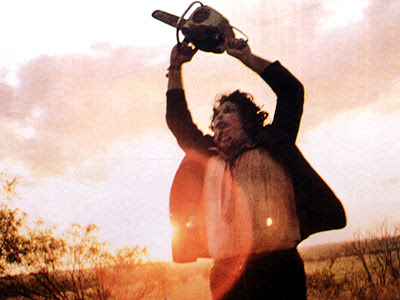
We actually saw this at Frightfest in London so they had a Q+A with the director himself afterwards. I say Q+A, but it was more like nauseatingly fanboyish leading questions and embarrassingly stilted answers. A good public speaker Tobe Hooper is not and I did feel a bit sorry for the man, forced to answer these inane questions from some guy who had once written a GCSE Film Studies essay about him. One comment that did interest me, though, was when Hooper was attempting to show how different he was trying to be with the film. "No Hollywood film would have the actor jump through two windows," he proudly says. And he's probably right, but not necessarily in a good way. You can watch the interview on Youtube and he also talks a little about the black comedy aspect of the film. Mercifully a lot of the most cringe-worthy questions seem to be cut out.
I don't want to sound too critical about it because we had a good time watching it and I would still recommend it highly to anyone. And it's certainly an "important" film in the history of cinema. It's not a masterpiece, though, but why should it have to be?
Anyway, there's probably little need to tell you what goes on in this film. It's famous and even if you haven't seen it (which I hadn't until the end of August) you still know it through the many films it's influenced and Simpsons jokes referencing it. If you've seen any of the modern slasher films, too, the plot will feel familiar — a group of kids on a trip to the country meet some bad folks and some grisly ends — but this was the landmark of the genre and if not the very first was certainly the most important. As such it should be treated as a historical piece as well as an individual work.
It's quite fun to look at the similarities with Star Wars. They're both pioneering films, financially successful, enormously influential and spawned several terrible sequels. Both directors gained great acclaim but never quite reached those heights again and had — creatively at least — quite disappointing careers. And they both had beards. But that's a little unfair on Tobe Hooper and The Texas Chain Saw Massacre is a much better film than Star Wars. But it's not a great film and to be honest I was a little underwhelmed seeing it for the first time after all the hype and expectation.
The first half hour works well, deftly building up tension in the usual way (see earlier comments on Suspiria). Then they get to the creepy old house, the tension ratchets up a few notches and the chain sawing starts. It's superb stuff — terrifying and visceral and very exciting. And considering it was made in 1974 when the audience's taste for such things wasn't quite as high as it is now makes it all the more impressive. I can quite believe all the stories about people fainting in cinemas and having to be stretchered out.
But then the film takes a bizarre left turn for the final act. We get to share a meal with Leatherface and his family and I'm not ashamed to admit I just didn't get it. It's a very poor attempt at black comedy, almost as if Hooper wanted to do a version of The Munsters but without being funny, and fits very strangely into the film that had gone before. Here's a quote from Wikipedia on the film's sequel, made in 1986:
"The emphasis in this sequel is on black comedy, which director Tobe Hooper believed was present in the first film, but unacknowledged by viewers because of its realistic and shocking content."
I like the way they say that Hooper believed it was present, as if he couldn't be sure. Or maybe he tried to put it in but it turned out so badly he decided that it wasn't there after all. Whatever the story, I'm afraid this spoiled the film for me a little. I'm happy to ignore those scenes and concentrate on the good points, of which there are plenty, but I shouldn't have to do that in a top 250 film.
We actually saw this at Frightfest in London so they had a Q+A with the director himself afterwards. I say Q+A, but it was more like nauseatingly fanboyish leading questions and embarrassingly stilted answers. A good public speaker Tobe Hooper is not and I did feel a bit sorry for the man, forced to answer these inane questions from some guy who had once written a GCSE Film Studies essay about him. One comment that did interest me, though, was when Hooper was attempting to show how different he was trying to be with the film. "No Hollywood film would have the actor jump through two windows," he proudly says. And he's probably right, but not necessarily in a good way. You can watch the interview on Youtube and he also talks a little about the black comedy aspect of the film. Mercifully a lot of the most cringe-worthy questions seem to be cut out.
I don't want to sound too critical about it because we had a good time watching it and I would still recommend it highly to anyone. And it's certainly an "important" film in the history of cinema. It's not a masterpiece, though, but why should it have to be?
Wednesday, 6 October 2010
94. Suspiria
This was on Film4 about a month ago as part of the run-up to FrightFest. It's a 1977 horror film which I'm astonished isn't as well known as other works in the genre, because it's clearly one of the best. How come Hallowe'en is shown once a year at a minimum, but Suspiria gets no more attention than a brief mention in Juno?
The plot isn't particularly revolutionary — a plucky virginal heroine heads off to a spooky dance school in Europe where people start getting bumped off — but the plot isn't so important as the style of the film. It's beautiful to look at with these wonderfully lit primary-coloured rooms. Some of the sets are quite reminiscent of The Conformist — it must be an Italian thing.

The masterstroke of director Dario Argento, though, is in the opening scenes. Most horror films like this open slowly, building up the tension, hinting at things to come and then gradually escalate to a great terrifying crescendo. That's standard fare and a lot of very good films have been made in this model (The Texas Chain Saw Massacre, reviewed next, being a prominent example). One problem with this, though, is that you get used to the film — its style and pacing — and you learn to predict, whether consciously or unconsciously, what is likely to happen. Argento, however, cunningly flips this on its head by putting all the best stuff right up front. As such, the first 20 minutes are unpredictable, disorienting, shocking and very frightening. You have no idea what's going on, no frame of reference for judging how bad it's going to get. Is it a supernatural villain or is it a human killer? Is the girl we're following the heroine of the film (and therefore safe from an early grave) or an expendable supporting character? You don't know.
As the film progresses things settle down to a more standard setup. The deaths happen at the usual intervals and in between the heroine researches the strange goings on, leading her on a path to the finale. That's not to say the deaths are uninteresting — far from it. They're just expected. Actually they're pretty cool and the girls die in lots of bizarre and sometimes extremely gruesome ways. This is not a film for the squeamish and you certainly get your money's worth in blood.
A word should be said about the soundtrack, by the Italian prog-rock group Goblin. It's just superb and plays a vital role in creating the eerie quality of the movie. Just a few notes of the main theme on the piano is enough to freak my little sister out — always a good talent to have up one's sleeve! What's interesting, too, is that it's not just the music on the soundtrack that works so well but the use of silence. A well-timed silence can send a shiver up your spine just as much as a haunting celeste.
I'm not totally convinced that this film will withstand repeat viewings because once it loses its shock and surprise it might not have a whole lot of substance to it. The Exorcist is such a great film because even after seeing it several times it's still totally enthralling. Scream, on the other hand, was enormous fun at the cinema but when I saw it again a few years later I could see the cracks. Where Suspiria comes in this hierarchy remains to be seen, but for any of you out there who haven't seen it yet, I couldn't recommend another horror film more highly.
The plot isn't particularly revolutionary — a plucky virginal heroine heads off to a spooky dance school in Europe where people start getting bumped off — but the plot isn't so important as the style of the film. It's beautiful to look at with these wonderfully lit primary-coloured rooms. Some of the sets are quite reminiscent of The Conformist — it must be an Italian thing.
The masterstroke of director Dario Argento, though, is in the opening scenes. Most horror films like this open slowly, building up the tension, hinting at things to come and then gradually escalate to a great terrifying crescendo. That's standard fare and a lot of very good films have been made in this model (The Texas Chain Saw Massacre, reviewed next, being a prominent example). One problem with this, though, is that you get used to the film — its style and pacing — and you learn to predict, whether consciously or unconsciously, what is likely to happen. Argento, however, cunningly flips this on its head by putting all the best stuff right up front. As such, the first 20 minutes are unpredictable, disorienting, shocking and very frightening. You have no idea what's going on, no frame of reference for judging how bad it's going to get. Is it a supernatural villain or is it a human killer? Is the girl we're following the heroine of the film (and therefore safe from an early grave) or an expendable supporting character? You don't know.
As the film progresses things settle down to a more standard setup. The deaths happen at the usual intervals and in between the heroine researches the strange goings on, leading her on a path to the finale. That's not to say the deaths are uninteresting — far from it. They're just expected. Actually they're pretty cool and the girls die in lots of bizarre and sometimes extremely gruesome ways. This is not a film for the squeamish and you certainly get your money's worth in blood.
A word should be said about the soundtrack, by the Italian prog-rock group Goblin. It's just superb and plays a vital role in creating the eerie quality of the movie. Just a few notes of the main theme on the piano is enough to freak my little sister out — always a good talent to have up one's sleeve! What's interesting, too, is that it's not just the music on the soundtrack that works so well but the use of silence. A well-timed silence can send a shiver up your spine just as much as a haunting celeste.
I'm not totally convinced that this film will withstand repeat viewings because once it loses its shock and surprise it might not have a whole lot of substance to it. The Exorcist is such a great film because even after seeing it several times it's still totally enthralling. Scream, on the other hand, was enormous fun at the cinema but when I saw it again a few years later I could see the cracks. Where Suspiria comes in this hierarchy remains to be seen, but for any of you out there who haven't seen it yet, I couldn't recommend another horror film more highly.
Tuesday, 31 August 2010
62. Les Vampires
There are a few films on the list that I'm not particularly looking forward to. Don't get me wrong — I'm sure Sátántangó is a fine film and will be worth watching, but the thought of sitting down to a 7 hour Hungarian epic about Communism doesn't immediately thrill me. The same was true of Les Vampires, a 10-part 1915 silent serial running to over 6 hours, but I gladly admit I was wrong to have my doubts — it's superbly entertaining and although it's almost a century old it still feels very fresh.
Les Vampires has nothing to do with blood-sucking creatures of the night. The title refers to a group of master criminals who terrorise Paris during World War One and the story revolves around young intrepid reporter Philippe Guérande and his faithful sidekick (and brilliantly named) Oscar-Cloud Mazamette fighting against their evil ways. All but the first couple of episodes run to about 45 minutes and they stand perfectly well on their own so you can watch them occasionally while eating your lunch. Here's a link to the first episode, one of the better and shorter ones so well worth a look to see if you'll like the rest.
There are a lot of things to enjoy. Some you might find in a Boy's Own adventure story or a Tintin comic: secret passages, treasure maps, disguises, daring escapes, car chases, cunning traps, hypnosis. Some are rather more macabre: murders, suicides, severed heads in boxes, poisoned rings that kill their wearers, gas chambers. The plots are imaginative and often quite labyrinthine — you have to keep focussed if you want to follow it all! The cast list is enormous, too, and the many disguises and impersonations don't always make it easy to tell who's doing what, but that's quite fun.
One thing I really love about these silent films, which applies equally to the Buster Keaton films I wrote about earlier, is how unconstrained by studio sets they are. Directors were perfectly happy to film outside or in a real house. In later years, this became too expensive to do well and the directors retreated to sound stages where everything could be measured and controlled. Les Vampires has a terrific freedom about it and hundreds of different locations. You get to see all sorts of aspects of 1915 Paris. To be sure, it was a desolate and miserable place — there was a war on and the Western Front wasn't too far away — but that only adds to the character and sense of time the film has.
The central characters themselves are interesting and you develop a fondness for them as the series progresses. Guérande the hero is a bit bland, but his colleague Mazamette is memorable — brave and loyal, but a bit of a clown and with a rough edge. The best thing about it, though, has to be Musidora, the actress who plays Irma Vep — probably the first screen femme fatale and one of the most beautiful. Strong and deadly with incredible intense eyes, she was also an acrobat so takes part in some of the film's best stunts. She steals the show and is much more interesting than the succession of evil bosses she works for.

The picture quality isn't always brilliant, but considering the film's age this isn't too big a deal. The music is really good and fits the on-screen action perfectly. The translation from the original French is done very well, too, and not just with the intertitles. If a character is reading a newspaper article or showing us his business card they will superimpose the English translation over the top so it was clearly produced with some loving care and attention.
Wouldn't it be great to live in a world where the BBC could show this weekly at 9pm on a Sunday evening and people would watch it? Unfortunately, today's audience could never get over the whole "they ain't saying anything" problem. A shame, because I think it stands up very well as a piece of entertainment and is easily a match for a lot of today's television fare.
Les Vampires has nothing to do with blood-sucking creatures of the night. The title refers to a group of master criminals who terrorise Paris during World War One and the story revolves around young intrepid reporter Philippe Guérande and his faithful sidekick (and brilliantly named) Oscar-Cloud Mazamette fighting against their evil ways. All but the first couple of episodes run to about 45 minutes and they stand perfectly well on their own so you can watch them occasionally while eating your lunch. Here's a link to the first episode, one of the better and shorter ones so well worth a look to see if you'll like the rest.
There are a lot of things to enjoy. Some you might find in a Boy's Own adventure story or a Tintin comic: secret passages, treasure maps, disguises, daring escapes, car chases, cunning traps, hypnosis. Some are rather more macabre: murders, suicides, severed heads in boxes, poisoned rings that kill their wearers, gas chambers. The plots are imaginative and often quite labyrinthine — you have to keep focussed if you want to follow it all! The cast list is enormous, too, and the many disguises and impersonations don't always make it easy to tell who's doing what, but that's quite fun.
One thing I really love about these silent films, which applies equally to the Buster Keaton films I wrote about earlier, is how unconstrained by studio sets they are. Directors were perfectly happy to film outside or in a real house. In later years, this became too expensive to do well and the directors retreated to sound stages where everything could be measured and controlled. Les Vampires has a terrific freedom about it and hundreds of different locations. You get to see all sorts of aspects of 1915 Paris. To be sure, it was a desolate and miserable place — there was a war on and the Western Front wasn't too far away — but that only adds to the character and sense of time the film has.
The central characters themselves are interesting and you develop a fondness for them as the series progresses. Guérande the hero is a bit bland, but his colleague Mazamette is memorable — brave and loyal, but a bit of a clown and with a rough edge. The best thing about it, though, has to be Musidora, the actress who plays Irma Vep — probably the first screen femme fatale and one of the most beautiful. Strong and deadly with incredible intense eyes, she was also an acrobat so takes part in some of the film's best stunts. She steals the show and is much more interesting than the succession of evil bosses she works for.
The picture quality isn't always brilliant, but considering the film's age this isn't too big a deal. The music is really good and fits the on-screen action perfectly. The translation from the original French is done very well, too, and not just with the intertitles. If a character is reading a newspaper article or showing us his business card they will superimpose the English translation over the top so it was clearly produced with some loving care and attention.
Wouldn't it be great to live in a world where the BBC could show this weekly at 9pm on a Sunday evening and people would watch it? Unfortunately, today's audience could never get over the whole "they ain't saying anything" problem. A shame, because I think it stands up very well as a piece of entertainment and is easily a match for a lot of today's television fare.
Saturday, 14 August 2010
77. Notorious
Last weekend I was idly channel surfing, looking for something to watch when I noticed this was just starting. Unfortunately I'd missed Spellbound, the first part of the Hitchcock double, but I stayed and watched Notorious to the end. I saw this film back in my University days one afternoon when I probably should have been revising but as I watched I realised I could remember almost nothing about it — it obviously made an impression on me!

The plot is fairly simple for a Hitchcock thriller. Cary Grant and Ingrid Bergman fall in love in post-war Rio while waiting for Bergman to start an assignment to infiltrate a group of Nazis. One of them — the always superb, and always seemingly slightly drunk, Claude Rains — is in love with her, a situation she uses to her advantage.
There are some great tense moments — vintage Hitchcock — but the film is really just a love story. The espionage stuff is practically a side-bar which barely bothers concluding itself and there are some interesting psychological issues (Rains' relationship with his mother exemplifying a typical Hitchcock theme). But it's the love triangle at the centre that's most compelling.
This is one of many similarities with Casablanca that really struck me. Along with Rains and Bergman, of course, we have Nazis, McGuffins, foreign locations, stoic leading men hiding their feelings, questions of love vs duty and so on. I think that's why Notorious made little impression on me the first time I saw it. For sure it's a classy and very well polished romantic thriller. The characters are interesting, deep and well portrayed. But it ain't no Casablanca, which has a lot of the good things that Notorious has, but with a superior script, better music and Peter Lorre.
They remade it in 2009 but while I'm all in favour of changing things in remakes — otherwise why bother? — I think they probably took it a bit far.
Wednesday, 28 July 2010
60. The Man Who Shot Liberty Valance
I was quite ignorant about this film, I must admit. Obviously, since it was directed by John Ford and starred Jimmy Stewart, John Wayne and Lee Marvin I knew it couldn't be bad but the cheesy Burt Bacharach title song did its reputation no favours and I'm ashamed to say I dismissed it as just another western. I recorded it when it was on TV about a year ago but I never got round to watching it. So when I found it on this list (which doesn't feature Stagecoach, Unforgiven and High Noon among other notable westerns) it was a little surprising. I was also very pleased when I discovered that the Bacharach song didn't have anything to do with the film either!
Jimmy Stewart plays a senator who returns with his wife to their home town to attend the funeral of an old friend. The newspaper men are curious to know the details of why he would come back to pay his respects to a "nobody" so he tells them the tale. It's fairly standard western fare for the most part: an educated and non-violent man from the East comes to town, gets robbed, tries to fight his battles using law and his sense of civilised justice but finds that the sword can be mightier than the pen. There are gunfights and saloons and tough men eating big steaks but there are also some interesting insights into American politics of the period which in some ways hasn't changed at all.
Stewart is always good, of course, but the standout performances here are from the supporting cast — particularly Edmund O'Brien as the newspaper editor who likes a drink and the sound of his own voice and Woody Strode as John Wayne's loyal sidekick. Wayne himself was a limited actor but had great screen presence and was constantly watchable — surely the definition of a true film star.
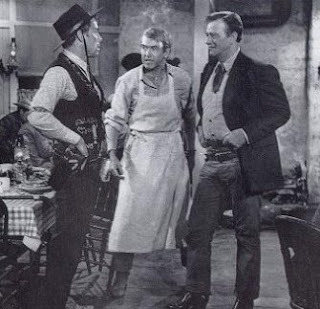
It's hard to talk too much about themes without giving away the ending. We have the old standby of so many westerns: civilisation coming to the West and how it parallels the story of the USA. We have the central triangle of Jimmy Stewart's idealist, John Wayne's pragmatist and Lee Marvin's anarchist — facets of a single character or facets of America itself? All very Film Studies 101 but there are some more interesting questions being asked here too — about the flexibility of law and the role of myth in American history. Its answers are quite pessimistic really, but I'll leave you to draw your own conclusions.
A top Western, and well worth its place at no. 60.
Jimmy Stewart plays a senator who returns with his wife to their home town to attend the funeral of an old friend. The newspaper men are curious to know the details of why he would come back to pay his respects to a "nobody" so he tells them the tale. It's fairly standard western fare for the most part: an educated and non-violent man from the East comes to town, gets robbed, tries to fight his battles using law and his sense of civilised justice but finds that the sword can be mightier than the pen. There are gunfights and saloons and tough men eating big steaks but there are also some interesting insights into American politics of the period which in some ways hasn't changed at all.
Stewart is always good, of course, but the standout performances here are from the supporting cast — particularly Edmund O'Brien as the newspaper editor who likes a drink and the sound of his own voice and Woody Strode as John Wayne's loyal sidekick. Wayne himself was a limited actor but had great screen presence and was constantly watchable — surely the definition of a true film star.
It's hard to talk too much about themes without giving away the ending. We have the old standby of so many westerns: civilisation coming to the West and how it parallels the story of the USA. We have the central triangle of Jimmy Stewart's idealist, John Wayne's pragmatist and Lee Marvin's anarchist — facets of a single character or facets of America itself? All very Film Studies 101 but there are some more interesting questions being asked here too — about the flexibility of law and the role of myth in American history. Its answers are quite pessimistic really, but I'll leave you to draw your own conclusions.
A top Western, and well worth its place at no. 60.
Wednesday, 21 July 2010
Statistics
So here are the facts and figures. I've based this all on 248 films — the 250 listed minus Family Feud and Song Cycle. Who the hell would be credited as directory of Family Feud anyhow? This also leaves in the entries which are double-counted, so you may want to mentally remove them from the figures: Vivre Sa Vie/My Life To Live, Dog Star Man/The Art of Vision and Pather Panchali/The Apu Trilogy. The last of those pairs should probably count as three, actually.
Not a big shock that USA and France lead the way, but perhaps a bit surprising that Italy and Germany are so high up. The poor old UK doesn't fare well at all and seems to be absent a lot of key works — where's David Lean? I suppose we should be consoled that there are a lot of British directors in the list.
So Godard wins it with 9 (which should probably be 8) ahead of crowd favourite Hitchcock. Interesting that there are only 3 American directors in the top ten, two of whom were from the silent era.
An indication that cinema has declined in the past thirty years, or just that it takes time to recognise a great film for what it is?
Colour or Black and White
150 out of the 248 are Black and White films (60%).Silent or Talkie
40 are silent films (16%).Countries Represented
This is slightly difficult as a lot of films have multiple nationalities. I tried where I could to pick the primary country of origin, which is usually the language spoken or the nationality of the director.| USA | 116 |
| France | 41 |
| Italy | 17 |
| Japan | 16 |
| Germany | 15 |
| USSR | 9 |
| UK | 9 |
| Denmark | 4 |
| Sweden | 4 |
| Poland | 3 |
| Belgium | 2 |
| India | 2 |
| Canada | 2 |
| Iran | 1 |
| Mexico | 1 |
| Hungary | 1 |
| Senegal | 1 |
| Hong Kong | 1 |
| Taiwan | 1 |
| Greece | 1 |
| Brazil | 1 |
Not a big shock that USA and France lead the way, but perhaps a bit surprising that Italy and Germany are so high up. The poor old UK doesn't fare well at all and seems to be absent a lot of key works — where's David Lean? I suppose we should be consoled that there are a lot of British directors in the list.
Directors
Here are the directors with two or more films to their name:| Jean-Luc Godard | 9 |
| Alfred Hitchcock | 7 |
| Robert Bresson | 6 |
| Buster Keaton | 6 |
| Akira Kurosawa | 6 |
| Yasujiro Ozu | 5 |
| Orson Welles | 5 |
| DW Griffith | 5 |
| Carl Theodor Dreyer | 5 |
| Stanley Kubrick | 4 |
| Stan Brakhage | 4 |
| Rainer Werner Fassbinder | 4 |
| John Ford | 4 |
| Howard Hawks | 4 |
| Charlie Chaplin | 4 |
| Sergei Eisenstein | 3 |
| Roberto Rossellini | 3 |
| Preston Sturges | 3 |
| Michelangelo Antonioni | 3 |
| Martin Scorsese | 3 |
| Jean Renoir | 3 |
| Ingmar Bergman | 3 |
| Federico Fellini | 3 |
| F W Murnau | 3 |
| William A Wellman | 2 |
| Werner Herzog | 2 |
| Vittorio de Sica | 2 |
| Satyajit Ray | 2 |
| Andrei Tarkovsky | 2 |
| Robert Altman | 2 |
| Douglas Sirk | 2 |
| Pier Paolo Pasolini | 2 |
| Oliver Stone | 2 |
| Nicholas Ray | 2 |
| Michael Powell | 2 |
| Max Ophüls | 2 |
| Chantal Akerman | 2 |
| Francis Ford Coppola | 2 |
| François Truffaut | 2 |
| Luis Buñuel | 2 |
| Louis Feuillade | 2 |
| Kenji Mizoguchi | 2 |
| John Cassavetes | 2 |
| Fritz Lang | 2 |
| James Cameron | 2 |
| Bernardo Bertolucci | 2 |
| Georges Méliès | 2 |
So Godard wins it with 9 (which should probably be 8) ahead of crowd favourite Hitchcock. Interesting that there are only 3 American directors in the top ten, two of whom were from the silent era.
Decades
Finally, a look at when these films were made:| 1900s | 2 |
| 1910s | 6 |
| 1920s | 28 |
| 1930s | 26 |
| 1940s | 28 |
| 1950s | 43 |
| 1960s | 48 |
| 1970s | 36 |
| 1980s | 19 |
| 1990s | 12 |
An indication that cinema has declined in the past thirty years, or just that it takes time to recognise a great film for what it is?
Unknown Films
I've now been through the whole list (and will post some statistics later) but there are a few question marks. Things would be much simpler if Thomas Edison laid down in law right from the start that every film could have only one title and every title could only belong to one film. Then you wouldn't have so many remakes — surely a good thing — and you'd also clear up a lot of confusion.
Imagine if a beautiful woman comes up to you in a bar and says "Hey baby, do you want to come back to my place to watch Crash on DVD?" Quite the dilemma, I'm confident you're all thinking. If she means the Paul Haggis film you'll surely regret saying yes as you sit there watching two hours of overwrought Oscar-grubbing. But if she means the Cronenberg film and you say no you'll miss out on a hell of a night. So you tiresomely ask her and she discards you and moves on to the next sap. Damn you Haggis! Why on earth would you title your film the same as a (better) film just 8 years older?
It's even worse when films have different titles in different countries. Which version the voters in this poll intended isn't always at all clear.
Take China Gate. There's a 1957 American war film of that title. It looks ok but hardly seems a must-see, so maybe they mean the 1998 Bollywood film instead? That gets a decent enough write-up too but I'd be surprised if anyone voted it best of the century. I can't believe either film is the one intended, but I can't find any other references out there. A puzzler.
Family Feud is equally puzzling. As Chris pointed out in the comments, this is the American version of rubbish gameshow Family Fortunes ("and our survey said..."). Surely they can't mean that, though, and this is really some sort of documentary or experimental work? Not that I can find anywhere.
Iliad has a number of possibilities. In the end I've gone for Manfred Noa's 1924 Helen of Troy which seems the most plausible but I could easily be wrong.
Imitation of Life could really be either version. Each seems equally likely to me. The same goes for The Ten Commandments but with that I'm guessing the 1956 version, mostly because that's the one I've seen.
L'Argent could be the fairly well-known 1983 Bresson film or the less well-known but apparently equally revered 1928 film.
Is Parade really just the 1974 Jacques Tati film about the circus? There seem a lot of films with this title, but that's the best of an unlikely bunch.
Song Cycle I have absolutely no clue about. There's the well-regarded Van Dyke Parks album with this title, but that won't be it. Nor will it be the 1928 film A Cycle of Songs which has received no votes on IMDB at all.
Any ideas?
Friday, 16 July 2010
Six Buster Keaton Films
There are six Buster Keaton films on the list and I'd only seen The General before, so I thought I'd tick the other five off and write about them in one go. For those of you who like old films, I highly recommend archive.org which has tons of silent films for free download. They're all out of copyright so it's perfectly legal. The quality's not always that good but it's still watchable.
In this first one — the most unconventional of the six — Buster plays a projectionist who wants to be a detective and tries to solve the case of a missing watch. But he's not very good at it and after a few comic misadventures his girlfriend finds the culprit without much trouble at all. The plot is more or less wrapped up in twenty minutes, but what follows is a dream sequence that takes up most of the rest of the film and features an awesome array of set-pieces as Buster jumps into a movie screen where he takes on the role of the super detective. Two scenes stand out, but it's all golden. First Buster jumps head-first through a window where he had carefully positioned a box, emerges from the other side wearing a dress that was in the box, and immediately imitates an old woman to evade his pursuers. You can't help but rewind it and watch it again and wonder how on earth it was filmed. The other notable scene is where Buster rides on the handlebars of a motorcycle (the other rider having fallen off) and negotiates various obstacles, collapsing bridges and oncoming trains. It's seriously dangerous stuff which you could never get away with filming nowadays but you have to just sit there and marvel at it.
The weakest of the six, The Navigator is more a series of sketches than a fully coherent narrative. There's some tenuous story about a young couple who get stranded on a passenger ship which is cast adrift on the ocean but it doesn't make much sense. The set-pieces range from the very good to the corny. In one Buster has trouble putting together a deck-chair — hilarious stuff! The underwater sequences are well done and the finale is quite impressive as the duo fight off a bunch of savage cannibals. It's not very politically correct, but it's very inventive and exciting. A good enjoyable film, but I have no idea why the person who voted it onto the list ranked it above the other five here.
The most modern of the six — the plot wouldn't look out of place in a 90's rom-com — this one has Buster needing to get married in a day in order to inherit a huge sum. He messes it up with his sweetheart but, undeterred, he goes on a quest to propose to anyone he can find. First he asks the seven single women at his club, with predictable results, then he walks down the street chatting up everybody he meets. He even approaches, unknowingly, a black woman, a Jew and a drag queen. Brilliant stuff — as if a white man could ever marry one of those people. Comedy gold.
Such dubious moments aside, though, this film is laden with gags, no more so than in the final segment where he's pursued by an army of brides-to-be as he races to marry his sweetheart (who's forgiven him) by the deadline. The stunts and acrobatics are astounding and genuinely more impressive than anything you find in today's cinema. Jackie Chan is said to have been inspired by Keaton but he never reached these heights.
If you watch this on Youtube (linked above), watch out for the colour scenes right at the start — not bad for 1925.
This is Keaton's Pet Sounds. The work which had gone before was undoubtedly very good, but he really stepped up with The General which is a more grown-up and polished film. Set in the American Civil War, Buster plays a man who is shunned by his friends for not being allowed to enlist in the Confederate army but gets caught up in events when some Unionists steal his beloved steam train (the eponymous General) and he heads off in pursuit. There's so much to love here, but the highlights have to be the two train chases which are so inventive and exciting. You wouldn't think that you could get much creative mileage from a chase sequence where the vehicles are confined to a linear track, but under Keaton's direction you get everything.
The General is quite critical of war and patriotism, a fairly brave statement at the time and probably why the film tanked at the box office. Most of the soldiers in the film are arrogant and pompous and generally a bit incompetent. Buster isn't much better. He runs rings around his enemies, but not usually from any great wit or superior soldiery — most of the time he succeeds by pure blind luck. The motives for war are noticeably absent, too. Buster doesn't seem interested in any of the reasons for fighting for the South — he just wants to look good wearing the uniform for his girl. Nor does he chase after the bad guys because he wants to stop the enemy from carrying out their dastardly plan, or even because he wants to save his lady from their evil clutches — he just wants to get his train back. He's still the hero, of course, and saves the day like every hero should. But he's a fairly pitiable hero, perhaps a point Keaton was trying to make about soldiers in general.
Incidentally, the version embedded above has a really weird soundtrack — it kicks off with Elgar for no particularly good reason and the first few minutes are quite hard to watch. I think it gets better later on, though. I have it on DVD where the soundtrack is a much more appropriate Scott Joplin. It's quite interesting how important sound is for a silent film! Also, ignore the title cards right at the start — they aren't on the DVD version and are both irrelevant and spoil the plot a little.
This one is a strange affair. Maybe it's because I saw this film last of the six, but it didn't impress me. It's 70 minutes long and the first 55 of them are pretty dire, to be frank. We're talking sub-Chuckle Brothers physical comedy as Buster falls off things, walks into things and tries on silly hats. I was struggling to keep watching, but I did know what was to come as this is the film with his most famous scene.
There really isn't much of a story. Buster is the public-school educated son of a salty old riverboat captain. His sweetheart is the daughter of a rival riverboat owner, but Romeo and Juliet this isn't. The dad gets arrested and Buster makes a bizarre attempt to free him from prison, though I'm not sure what would have happened if he'd succeeded. But then a cyclone hits and the film changes completely. The last 15 minutes are truly magnificent as the town is destroyed by the winds. We see houses lift up off their foundations, trees being uprooted and blown across town, buildings topple over and in amongst the wreckage flies Buster. Some of the scenes are quite remarkable and have rightly gone down in cinema history. The rumour was that he was suicidal and so took ridiculous risks for the sake of making these sensational stunts but whatever the truth, the end product is amazing.
It's still worth sitting through the movie to get to the end, but you're probably better off just fast-forwarding it to its conclusion.
This was Keaton's first movie for MGM and the last of his great films. MGM would afterwards remove creative control and therefore all that was good about his films. Morons. Buster plays a cameraman who wants to shoot footage for the news and win the heart of a girl who works at the news office. There's nothing particularly new or revolutionary about this film compared to the other five — it's just a very well executed comedy. Again, it's the finale that impresses with two brilliant scenes. First, a shootout between rival Chinese gangs and then a boating accident and daring rescue. The rest of the film is pretty good, too, although the visit to the swimming pool feels a bit out of place in the middle.
Buster also gets himself a monkey sidekick, which can never be a bad thing. I think most films could be improved if the hero had a monkey sidekick.
I was already a Buster Keaton fan on the basis of one film, but now I've seen all these six my love for the little stony-faced acrobat is confirmed. Nevertheless, I am a little surprised at how well some of these films rank. The General, of course, is rightly near the top of the pile. An almost perfect film, Orson Welles said it was the greatest comedy ever, the greatest war film ever and probably the greatest film ever too. Sherlock, Jr. is imaginative and fantastical and tremendous fun. The rest also have moments of brilliance — some more than others — but are still fairly patchy. I'll concede that Steamboat Bill, Jr. should be included on the basis of its final act alone, but I'm not convinced about the rest. But who cares — they're all terrific entertainment even after all these years and it would take a very cold-hearted person to sit through them without a big grin on their face.
P.S. It seems the embedded videos are too wide to fit in this column, and I don't really want to widen the column. If you do want to watch them, you'll have to full-screen it (the button that's cut off furthest on the right) or go to archive.org and see them there.
37. Sherlock, Jr. (1924)
In this first one — the most unconventional of the six — Buster plays a projectionist who wants to be a detective and tries to solve the case of a missing watch. But he's not very good at it and after a few comic misadventures his girlfriend finds the culprit without much trouble at all. The plot is more or less wrapped up in twenty minutes, but what follows is a dream sequence that takes up most of the rest of the film and features an awesome array of set-pieces as Buster jumps into a movie screen where he takes on the role of the super detective. Two scenes stand out, but it's all golden. First Buster jumps head-first through a window where he had carefully positioned a box, emerges from the other side wearing a dress that was in the box, and immediately imitates an old woman to evade his pursuers. You can't help but rewind it and watch it again and wonder how on earth it was filmed. The other notable scene is where Buster rides on the handlebars of a motorcycle (the other rider having fallen off) and negotiates various obstacles, collapsing bridges and oncoming trains. It's seriously dangerous stuff which you could never get away with filming nowadays but you have to just sit there and marvel at it.
220. The Navigator (1924)
The weakest of the six, The Navigator is more a series of sketches than a fully coherent narrative. There's some tenuous story about a young couple who get stranded on a passenger ship which is cast adrift on the ocean but it doesn't make much sense. The set-pieces range from the very good to the corny. In one Buster has trouble putting together a deck-chair — hilarious stuff! The underwater sequences are well done and the finale is quite impressive as the duo fight off a bunch of savage cannibals. It's not very politically correct, but it's very inventive and exciting. A good enjoyable film, but I have no idea why the person who voted it onto the list ranked it above the other five here.
112. Seven Chances (1925)
(watch this one on Youtube)The most modern of the six — the plot wouldn't look out of place in a 90's rom-com — this one has Buster needing to get married in a day in order to inherit a huge sum. He messes it up with his sweetheart but, undeterred, he goes on a quest to propose to anyone he can find. First he asks the seven single women at his club, with predictable results, then he walks down the street chatting up everybody he meets. He even approaches, unknowingly, a black woman, a Jew and a drag queen. Brilliant stuff — as if a white man could ever marry one of those people. Comedy gold.
Such dubious moments aside, though, this film is laden with gags, no more so than in the final segment where he's pursued by an army of brides-to-be as he races to marry his sweetheart (who's forgiven him) by the deadline. The stunts and acrobatics are astounding and genuinely more impressive than anything you find in today's cinema. Jackie Chan is said to have been inspired by Keaton but he never reached these heights.
If you watch this on Youtube (linked above), watch out for the colour scenes right at the start — not bad for 1925.
32. The General (1927)
This is Keaton's Pet Sounds. The work which had gone before was undoubtedly very good, but he really stepped up with The General which is a more grown-up and polished film. Set in the American Civil War, Buster plays a man who is shunned by his friends for not being allowed to enlist in the Confederate army but gets caught up in events when some Unionists steal his beloved steam train (the eponymous General) and he heads off in pursuit. There's so much to love here, but the highlights have to be the two train chases which are so inventive and exciting. You wouldn't think that you could get much creative mileage from a chase sequence where the vehicles are confined to a linear track, but under Keaton's direction you get everything.
The General is quite critical of war and patriotism, a fairly brave statement at the time and probably why the film tanked at the box office. Most of the soldiers in the film are arrogant and pompous and generally a bit incompetent. Buster isn't much better. He runs rings around his enemies, but not usually from any great wit or superior soldiery — most of the time he succeeds by pure blind luck. The motives for war are noticeably absent, too. Buster doesn't seem interested in any of the reasons for fighting for the South — he just wants to look good wearing the uniform for his girl. Nor does he chase after the bad guys because he wants to stop the enemy from carrying out their dastardly plan, or even because he wants to save his lady from their evil clutches — he just wants to get his train back. He's still the hero, of course, and saves the day like every hero should. But he's a fairly pitiable hero, perhaps a point Keaton was trying to make about soldiers in general.
Incidentally, the version embedded above has a really weird soundtrack — it kicks off with Elgar for no particularly good reason and the first few minutes are quite hard to watch. I think it gets better later on, though. I have it on DVD where the soundtrack is a much more appropriate Scott Joplin. It's quite interesting how important sound is for a silent film! Also, ignore the title cards right at the start — they aren't on the DVD version and are both irrelevant and spoil the plot a little.
46. Steamboat Bill, Jr. (1928)
This one is a strange affair. Maybe it's because I saw this film last of the six, but it didn't impress me. It's 70 minutes long and the first 55 of them are pretty dire, to be frank. We're talking sub-Chuckle Brothers physical comedy as Buster falls off things, walks into things and tries on silly hats. I was struggling to keep watching, but I did know what was to come as this is the film with his most famous scene.
There really isn't much of a story. Buster is the public-school educated son of a salty old riverboat captain. His sweetheart is the daughter of a rival riverboat owner, but Romeo and Juliet this isn't. The dad gets arrested and Buster makes a bizarre attempt to free him from prison, though I'm not sure what would have happened if he'd succeeded. But then a cyclone hits and the film changes completely. The last 15 minutes are truly magnificent as the town is destroyed by the winds. We see houses lift up off their foundations, trees being uprooted and blown across town, buildings topple over and in amongst the wreckage flies Buster. Some of the scenes are quite remarkable and have rightly gone down in cinema history. The rumour was that he was suicidal and so took ridiculous risks for the sake of making these sensational stunts but whatever the truth, the end product is amazing.
It's still worth sitting through the movie to get to the end, but you're probably better off just fast-forwarding it to its conclusion.
112. The Cameraman (1928)
This was Keaton's first movie for MGM and the last of his great films. MGM would afterwards remove creative control and therefore all that was good about his films. Morons. Buster plays a cameraman who wants to shoot footage for the news and win the heart of a girl who works at the news office. There's nothing particularly new or revolutionary about this film compared to the other five — it's just a very well executed comedy. Again, it's the finale that impresses with two brilliant scenes. First, a shootout between rival Chinese gangs and then a boating accident and daring rescue. The rest of the film is pretty good, too, although the visit to the swimming pool feels a bit out of place in the middle.
Buster also gets himself a monkey sidekick, which can never be a bad thing. I think most films could be improved if the hero had a monkey sidekick.
I was already a Buster Keaton fan on the basis of one film, but now I've seen all these six my love for the little stony-faced acrobat is confirmed. Nevertheless, I am a little surprised at how well some of these films rank. The General, of course, is rightly near the top of the pile. An almost perfect film, Orson Welles said it was the greatest comedy ever, the greatest war film ever and probably the greatest film ever too. Sherlock, Jr. is imaginative and fantastical and tremendous fun. The rest also have moments of brilliance — some more than others — but are still fairly patchy. I'll concede that Steamboat Bill, Jr. should be included on the basis of its final act alone, but I'm not convinced about the rest. But who cares — they're all terrific entertainment even after all these years and it would take a very cold-hearted person to sit through them without a big grin on their face.
P.S. It seems the embedded videos are too wide to fit in this column, and I don't really want to widen the column. If you do want to watch them, you'll have to full-screen it (the button that's cut off furthest on the right) or go to archive.org and see them there.
Wednesday, 23 June 2010
82. A Trip to the Moon
Easily the oldest film on the list, Le Voyage Dans La Lune is now 108 years old. There are various versions out there — short versions (at 25 fps and therefore speeded up from the original), long versions (the original 16 fps), versions with rock music, versions with narration, colourised versions, etc. etc. The first version I saw had just a soundtrack but it's impossible to follow. This version made sense of the story by reading the original script like they would have done at the theatre it was first shown, but the sound is fairly amateurish:
The film is pretty poor, frankly. Yes, it's groundbreaking, it has great special effects for its time and fantastical sets. It's also admirably ambitious. Where other film makers were content with replicating a stage play on the big screen, Georges Méliès made a science fiction movie with aliens and rocket ships. I recommend you all watch it as it's an intriguing bit of film history but, as a film, it's pretty terrible. The plot is nonsense and just involves a bunch of magicians flying to the moon, killing off some natives and falling back to earth. It's cartoonish but not in a good way.
There isn't really any acting to speak of, either. Part of this might be down to the narrative style of the film being so alien — directors hadn't yet learned the language of cinema and how to tell a story in the new medium. There are no close-ups — just a static camera sitting away from the action as if we're in the front row of the theatre. There's no voice acting either (duh) so there's no way for the actors to express themselves other than jumping around and pointing at things — you don't see their faces. It just feels very clunky.
It does have one glorious moment, though, and that's the iconic image we've all seen before of the rocket flying into the moon's eye. It's worth it for that at least.

It's not the oldest film I've seen, though. That would be this. Cool to say you've seen it, but that's as far as it goes. Why is the old woman in the background walking backwards, though?
The film is pretty poor, frankly. Yes, it's groundbreaking, it has great special effects for its time and fantastical sets. It's also admirably ambitious. Where other film makers were content with replicating a stage play on the big screen, Georges Méliès made a science fiction movie with aliens and rocket ships. I recommend you all watch it as it's an intriguing bit of film history but, as a film, it's pretty terrible. The plot is nonsense and just involves a bunch of magicians flying to the moon, killing off some natives and falling back to earth. It's cartoonish but not in a good way.
There isn't really any acting to speak of, either. Part of this might be down to the narrative style of the film being so alien — directors hadn't yet learned the language of cinema and how to tell a story in the new medium. There are no close-ups — just a static camera sitting away from the action as if we're in the front row of the theatre. There's no voice acting either (duh) so there's no way for the actors to express themselves other than jumping around and pointing at things — you don't see their faces. It just feels very clunky.
It does have one glorious moment, though, and that's the iconic image we've all seen before of the rocket flying into the moon's eye. It's worth it for that at least.
It's not the oldest film I've seen, though. That would be this. Cool to say you've seen it, but that's as far as it goes. Why is the old woman in the background walking backwards, though?
Subscribe to:
Posts (Atom)